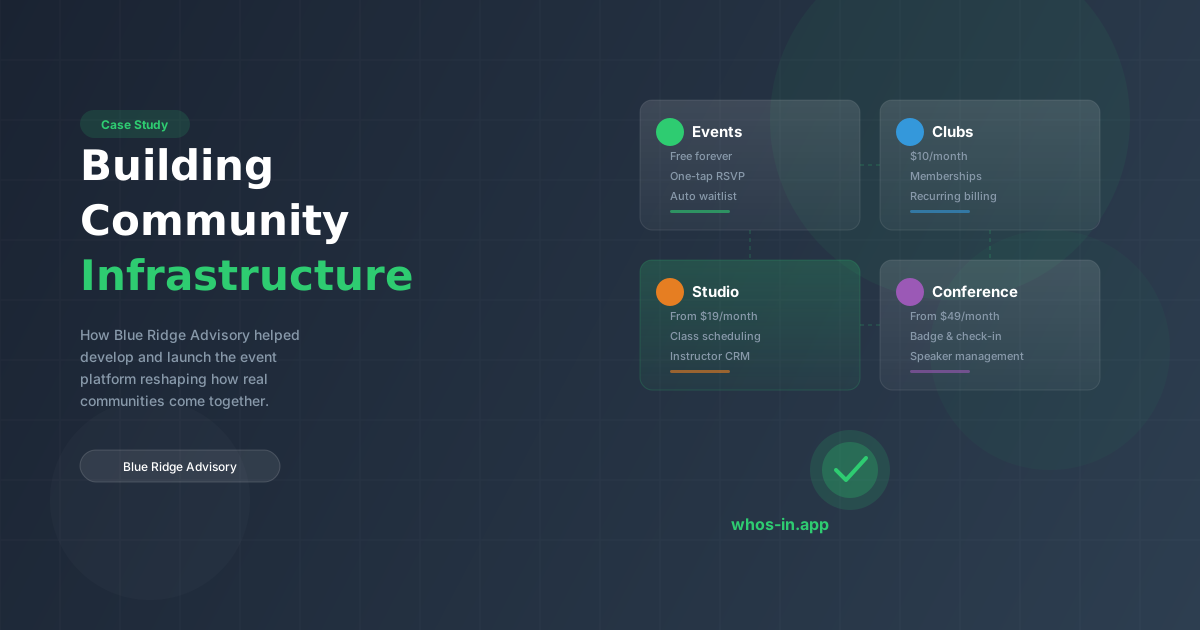
In late 2024, Blue Ridge Advisory began working with a founder who had identified a deceptively simple problem: organising a weekly football game in Bali shouldn't require a spreadsheet, three WhatsApp groups, and a mental model of who paid last week. That founder built the first version of Who's In to scratch his own itch. What emerged is now one of the most compelling event technology platforms we've seen: genuinely free, thoughtfully designed, and quietly expanding into a four-product suite that challenges incumbents at every tier.
This article documents our involvement in Who's In's development and provides a comprehensive review of what the platform offers today — from free community events to professional conference management.
The Problem with Event Platforms
Anyone who has organised recurring events — whether that's a Sunday run club, a yoga class, or a quarterly investor dinner — knows the frustration. The existing tools fall into two camps: consumer apps that are too simple and lack essential features, or enterprise platforms that charge hundreds of dollars per month for functionality most organisers don't need.
Eventbrite charges 3.7% plus $1.79 per ticket. Luma takes 7%. Mindbody starts at $139 per month for fitness studios. Cvent charges $5,000 or more per year for conference management. And most of these platforms require your guests to create accounts before they can RSVP — an unnecessary barrier that kills conversion.
The gap in the market wasn't about building another event tool. It was about building the right event tool — one that respects both the organiser's budget and the attendee's time.
Blue Ridge's Role
Our engagement with Who's In covered several dimensions of our Startup Growth Advisory practice. We provided strategic guidance on product positioning, go-to-market strategy, and the commercial architecture that would allow the platform to offer a genuinely free tier while building sustainable revenue streams through premium products.
A key strategic decision — one we advocated strongly for — was the "free forever" positioning for the core Events product. In a market where every competitor monetises through per-ticket fees, subscriptions, or both, offering the full feature set at zero cost creates an extraordinary acquisition advantage. The economics work because the platform's paid tiers — Clubs, Studio, and Conference — serve distinct audiences with specialised needs, and the free Events product is the natural top of funnel.
We also advised on the platform's internationalisation strategy. Who's In now supports ten languages — English, Spanish, French, Portuguese, Arabic, Hebrew, Swedish, German, Hindi, and Indonesian — reflecting both the founder's global perspective and the platform's ambition to serve communities regardless of geography.
Who's In Events: Free Forever, No Compromises
Who's In Events is the foundation of the platform and arguably its most disruptive product. Every feature is free. There is no monthly subscription, no per-event charge, and no feature gating. The only fee is a flat 2.7% on paid ticket sales — and free events cost nothing at all.
To put that in context: for a 100-person event with $25 tickets, Who's In charges approximately $67 in total fees. Eventbrite would charge over $270 for the same event. For free events — which represent the majority of community gatherings — Who's In costs literally nothing.
What makes it different
The feature that impressed us most during development was the one-tap RSVP. Guests don't need to create an account, download an app, or remember a password. The organiser shares a link — via WhatsApp, email, or any channel — and the guest taps a button. That's it. In a world where every platform demands registration before participation, this respect for the attendee's time is a genuine differentiator.
The automatic waitlist is equally thoughtful. When an event reaches capacity, additional RSVPs are automatically waitlisted. When someone cancels, the next person on the waitlist is promoted in real time and notified immediately. No manual management, no chasing people — the system handles it.
Morning-of reconfirmation tackles the perennial no-show problem. Attendees receive a reconfirmation prompt on the day of the event, and those who don't respond can be replaced from the waitlist. For organisers running events with limited capacity — fitness classes, dinner parties, workshops — this alone justifies choosing the platform.
Other notable features include Apple Wallet and Google Wallet passes, QR code check-in with offline support, recurring event scheduling, custom branding, calendar sync, and a public events directory.
Who it's for
Events is built for anyone who brings people together: sports groups, book clubs, yoga communities, corporate social committees, university societies, birthday celebrations, and everything in between. The platform supports 21 event categories from hiking to meditation to art exhibitions.
Who's In Clubs: Membership Management for Recurring Communities
Who's In Clubs extends the platform for communities that need ongoing membership management. At $10 per month for organisers — free for members — it provides the infrastructure for running clubs, cycling groups, photography societies, wine tasting circles, sailing clubs, and any group that meets regularly and wants to manage its community properly.
Key capabilities
Membership tiers allow clubs to offer both free and paid membership levels, each with configurable access to events and content. A running club might offer a free tier for casual participants and a paid tier for members who want access to coached sessions, for example.
Recurring billing through Stripe handles the tedious work of chasing membership renewals. Members pay automatically, and the club gets paid directly to their bank account.
Group messaging keeps the community connected between events. Attendance tracking gives organisers visibility into who's actually showing up versus who's on the roster. Private member-only events allow clubs to restrict certain gatherings to active members.
The pricing — $10 per month — positions Clubs as dramatically cheaper than alternatives like Mighty Networks or Circle, while focusing specifically on the needs of real-world communities that meet in person rather than online-only groups.
Who's In Studio: Challenging Mindbody at a Tenth of the Price
Who's In Studio is perhaps the most commercially ambitious product in the suite. Starting at $19 per month — with a Pro tier at $49 per month — it directly targets the fitness and wellness market currently dominated by Mindbody ($139/month), Vagaro ($85/month), and Glofox.
Built for instructors and studio owners
Studio provides class scheduling with recurring sessions, instructor management for multi-teacher operations, and a client booking system that inherits the platform's one-tap simplicity. Clients book classes through a branded booking page — no generic marketplace, no competing listings, just the studio's own presence.
The CRM functionality tracks client relationships, attendance patterns, and membership status. Membership management handles class packs, unlimited memberships, and drop-in pricing through Stripe.
The product serves a wide range of disciplines: yoga, Pilates, dance, CrossFit, martial arts, meditation, personal training, barre, cycling, and wellness retreats.
The pricing disruption
Studio owners are often sole proprietors or small teams operating on thin margins. Paying $139 per month or more for scheduling software — before rent, insurance, and instructor pay — is a meaningful burden. Who's In Studio delivers comparable functionality at $19 per month, freeing capital that can be reinvested in the business. The platform operates in major studio markets worldwide including London, New York, Dubai, Singapore, Sydney, and Bali.
Who's In Conference: Professional Events Without the Enterprise Price Tag
Who's In Conference brings the platform's philosophy to the professional events space. Starting at $49 per month — with a Pro tier at $149 per month — it offers the tools that Cvent charges $5,000 or more per year for and Whova charges $2,000 or more per year for.
Full-stack conference management
Registration management handles attendee sign-ups with custom fields, ticket tiers, and early-bird pricing. Badge generation produces both digital and printable badges. QR check-in with offline support ensures smooth entry even without reliable venue Wi-Fi.
Speaker management provides tools for managing proposals, bios, schedules, and communications. Sponsor management handles tiered sponsor packages and visibility. A branded attendee portal gives participants a single destination for schedules, speaker information, and networking.
Conference serves a broad range of professional events: tech conferences, academic symposiums, medical conferences, trade shows, hackathons, demo days, corporate retreats, and industry summits.
The Technical Foundation
From an advisory perspective, the technical decisions behind Who's In reflect the founder's product discipline. The platform is built as a Progressive Web App on React 18 and Tailwind CSS with a Firebase backend — a stack chosen for speed of iteration and global reliability rather than over-engineering.
Payments run through Stripe Connect, which means organisers receive payouts directly to their bank accounts rather than through the platform. This is a trust signal that matters: the organiser's money is their money, and Who's In never holds it.
The platform also offers a public REST API with OpenAPI 3.1 documentation, webhook support, and — notably — AI agent integration via OAuth 2.0 with ChatGPT, Claude, and Gemini. This forward-thinking approach to AI interoperability means that event discovery and RSVP can happen conversationally through AI assistants, not just through traditional web interfaces.
What Sets Who's In Apart
Having worked with numerous technology startups across our Startup Growth Advisory and Fund & Portfolio Advisory practices, we've seen what separates platforms that gain traction from those that don't. Several characteristics distinguish Who's In:
No guest account required. This seems small but it's transformative. Every friction point in the RSVP process costs attendees. By eliminating registration entirely for guests, Who's In achieves conversion rates that account-gated platforms simply cannot match.
Progressive complexity. An organiser can start with a free event in minutes. As their needs grow — recurring community, fitness classes, professional conferences — the platform grows with them. There's no migration, no data export, no starting over on a new tool.
Transparent pricing. The pricing is refreshingly straightforward. Free means free. The 2.7% fee on paid tickets is a flat rate with no hidden surcharges. Paid tiers are fixed monthly amounts. Compare this to enterprise platforms where pricing requires a sales call and a multi-page contract.
WhatsApp-native design. In markets across the GCC, Southeast Asia, Europe, and Latin America, WhatsApp is how people communicate. Who's In was built with WhatsApp sharing as a first-class feature, not an afterthought. Pre-filled message templates make sharing events feel natural within the conversations where plans are actually made.
Privacy by design. The platform defaults to GA4 consent denied — no tracking without explicit user opt-in. In an industry where event platforms routinely harvest attendee data for marketing purposes, this is a meaningful differentiation.
Competitive Landscape
Who's In operates across multiple competitive categories, and their comparison pages provide detailed breakdowns. In summary:
vs. Eventbrite: Who's In is significantly cheaper (2.7% flat vs. 3.7% + $1.79/ticket), includes features Eventbrite charges extra for (waitlists, reconfirmation, wallet passes), and doesn't require guest accounts.
vs. Partiful / Luma: Who's In matches or exceeds the feature set of Partiful and Luma while charging less. Luma's 7% fee is particularly notable — nearly three times Who's In's rate.
vs. Mindbody / Vagaro: Who's In Studio at $19/month vs. Mindbody at $139/month is the most dramatic pricing gap in the suite. The feature set covers what most independent studios and instructors actually need without the bloat of marketplace features that primarily benefit the platform.
vs. Cvent / Whova: Conference at $49/month targets the same functionality as enterprise tools costing thousands per year, making professional conference management accessible to smaller organisations, academic departments, and community-run events that could never justify enterprise pricing.
Resources and Tools
Beyond the core platform, Who's In has built an extensive ecosystem of resources. Their resource hub spans over 670 pages covering event planning guides, invitation templates, RSVP checklists, and event name ideas across dozens of niches. Interactive tools include an attendance predictor, no-show calculator, fee calculator, and studio capacity calculator. A glossary of 152 event planning terms and a help centre with over 40 articles round out the self-service offering.
Our Assessment
At Blue Ridge Advisory, we've had the privilege of working with the Who's In team from early development through to a platform that now serves communities across multiple continents and ten languages. The founder's background in product development at major technology companies is evident in the platform's attention to detail, its resistance to feature bloat, and its unwavering focus on the end user's experience.
What makes Who's In particularly interesting from an advisory perspective is the market timing. The shift toward community-led events, the growth of the fitness and wellness economy, the professionalisation of conference management, and the global proliferation of remote communities all create tailwinds for a platform designed to serve these needs at accessible price points.
The "free forever" Events tier is both a bold commercial bet and a sound strategic move. By removing cost as a barrier to adoption, Who's In can build the kind of organic distribution — one event shared to one group chat at a time — that paid platforms struggle to replicate. And as those organisers' needs evolve, Clubs, Studio, and Conference are there to serve them.
If you're running events, managing a community, teaching classes, or organising conferences, Who's In is worth your attention. And if you're building something equally ambitious, we'd like to hear about it.
Building a Product That Needs Strategic Advisory?
Blue Ridge provides board-level guidance for startups navigating growth — from product strategy to go-to-market execution.
Schedule a Consultation